Why Developers Are Choosing "No AI" Search — And What It Signals
There is a quiet rebellion happening in the search bar.
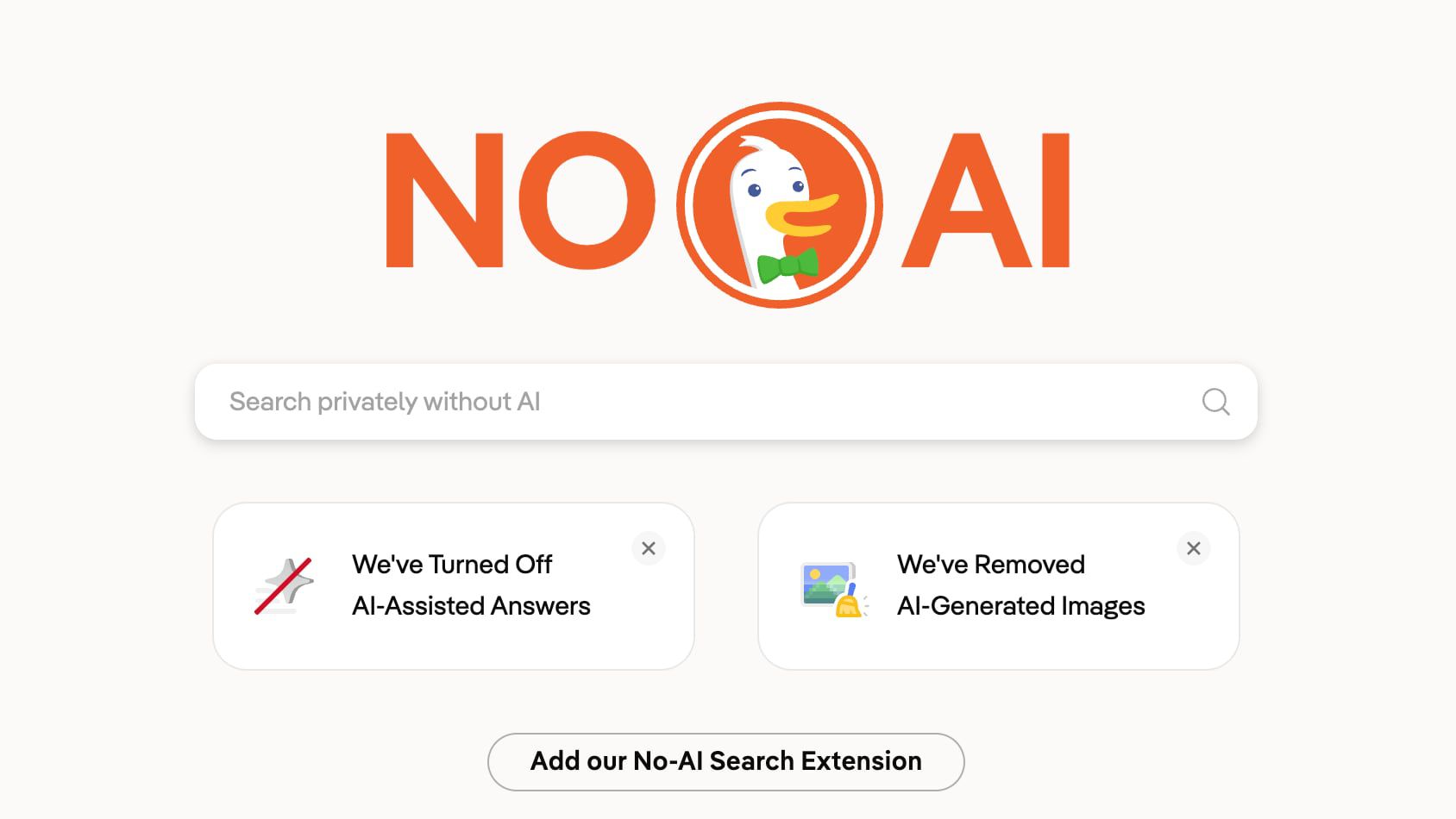
Following Google's May 2025 I/O keynote — where AI Overviews were expanded and made more prominent than ever — a measurable segment of users migrated toward DuckDuckGo specifically to use its opt-out "No AI" search mode. The numbers are not a blip. They represent a considered preference: some users actively want search results without an AI layer interpreting, summarising, or reordering them first.
For software teams and SaaS founders, this is more than a browser stat. It is a product signal worth reading carefully.
What "No AI" Search Actually Means
DuckDuckGo's "No AI" mode strips out AI-generated summaries and answer cards, returning a clean, ranked list of web results. No synthesised paragraphs. No citations pulled from multiple sources and blended into a single confident-sounding answer. Just links.
To many engineers, that sounds like a step backward. But that is precisely the point for the users choosing it. Their objections tend to fall into a few categories:
- Trust and verifiability — When a search engine synthesises an answer, the original source is abstracted away. Users who need to verify claims, read primary sources, or audit a recommendation find the AI layer obstructive rather than helpful.
- Precision over convenience — Developers, researchers, and power users often know what they are looking for. They do not need a summary; they need the right URL fast.
- Privacy as a first principle — DuckDuckGo's core audience already self-selected for privacy. For them, feeding query context into a large language model pipeline — even one on the search provider's side — feels like an unwanted extension of the data relationship.
The AI Integration Backlash Is Not Anti-Technology
It would be a mistake to read this trend as technophobia. The users turning off AI search are, in many cases, the same people who use Copilot in their IDEs, run local LLMs, or build with AI APIs professionally. The objection is not to AI. It is to unsolicited AI intermediation of a workflow they already had working.
This is a useful distinction for any product team embedding AI features into existing tools.
There is a difference between AI that augments a task the user has asked for help with and AI that restructures a familiar interface without consent. Google's AI Overviews sit in the second category for a portion of its user base — and those users are now voting with their clicks.
What This Means for SaaS and Software Product Teams
If you are building a product with an AI-assisted layer — a search function, a recommendation engine, an auto-complete, a summarisation feature — this trend carries a direct lesson.
Give users the dial.
The products that will retain trust over the next few years are the ones that make AI features composable and optional, not mandatory and invisible. Consider how this maps to your own architecture:
// Example: Feature-flagged AI results in a search response
{
  "query": "invoice reconciliation",
  "ai_summary_enabled": false,   // user preference stored per session
  "results": [
    { "title": "...", "url": "...", "score": 0.97 },
    ...
  ]
}
A simple boolean preference like this in your search or content API is not a feature downgrade. It is a trust mechanism. Users who turn it off are not lost users — they are retained users who felt respected enough to stay.
Three Practical Takeaways
-
Default on, opt-out available — AI features can still be default-enabled for new users (where they provide the most visible value) as long as opting out is frictionless and persistent.
-
Transparency about what the AI is doing — If your product summarises, ranks, or filters content using a model, say so. A one-line label — "AI-ranked results" or "Summary generated by AI" — reduces the sense of hidden intermediation that frustrates power users.
-
Separate the pipeline from the presentation — Architecturally, keep your AI inference layer decoupled from your results layer. This makes it easier to toggle AI features per user, per plan tier, or per use case — and it makes your system easier to test and audit.
The Broader Market Shift
DuckDuckGo's growth in this specific mode is one data point in a larger pattern. Perplexity has built a significant user base by doing AI search transparently, with citations front and centre. Arc Search tried aggressive AI summarisation and faced pushback. Kagi built a paid search product partly on the premise that users will pay to control their results quality.
The common thread: users want agency over how much AI involvement they get, and the products that offer that agency are differentiating on it.
For African tech markets — including Ghana, where mobile data costs and search intent are often highly specific — this matters even more. Users searching for a vendor, a service, or a technical answer rarely benefit from a generalised AI summary. They benefit from a precise, fast, trustworthy result. Building with that in mind is not a retreat from AI; it is a more sophisticated application of it.
Why This Matters for Your Project
Whether you are building a SaaS platform with internal search, a marketplace with product discovery, or a mobile app with content feeds, the DuckDuckGo trend is a reminder that AI features earn their place by improving outcomes — not by being present. The teams that instrument user preferences, measure engagement on AI-assisted versus standard results, and iterate accordingly will build better products than those that ship AI as a default and call it done.
Source: MacRumors — DuckDuckGo's 'No AI' Search Traffic Climbs as Users Reject Google's AI Overhaul